
UnPhiltered (Part 2)
Catch up on the latest installments of my writing life saga

Read Chapters 1-4 of UnPhiltered: the first 20 years of my writing life.
Chapter 5 — An Imaginary Machine Gun
23rd December 2015. I’m stuck in Madrid airport. Flight cancelled.
I’m holding a ukulele case, but when a fellow stranded passenger asks what instrument I play, I look over my shoulder, then whisper that it’s a Uzi.
I eventually escape the airport with no security issues, but that imaginary weapon becomes the reason I write stories today.
Why?
A few months later, I saw a writing competition on Twitter. “Comment with the first line of a story,” they said. “The best one wins a free spot on our next short-fiction course.
There was no way I would have paid the 480 pounds to take an online course, but I had a strong feeling that my cheesy machine-gun line would win the prize. It did, and I was thrust into studying and writing short fiction for 6 weeks.
This was my first time studying an online course. Nowadays we click through the materials at light speed and put the videos on 2.5x speed to ‘get to the end’. Back then, I took time to study, read, consider, comment, and submit my work.
I can’t remember which stories we read (maybe O. Henry, Dickens, D.H. Lawrence — that kind of thing). The course broke down the aspects for short stories like characters, descriptions, point of view, tense and time, form etc.
Before the course, I never read short stories. They weren’t well rounded narratives like movies or novels. “What’s the point if it’s not finished.” During 2016, I realised that short stories are not magazine fillers or training wheels for authors. It’s an art form which may not be en vogue (or commercially viable), but one which can make a reader think or feel just as much as a 500-page book.
Since then, I’ve read over 1,000 short stories, and written over 100. Yes, it’s a bit of a writerly, insular world, short fiction, but they are beautiful puzzles. Typical hero’s journeys or 3-act screenplays feel static and predictable compared to the kaleidoscope shapes and forms of short stories.
Most of all, the reader does a lot of the writing themselves, filling in gaps and considering the unwritten ending.
Some of my favourite short-story authors:
V.S. Pritchett, Jose Luis Borges, Flannery O’Connor, Anton Chekhov, Raymond Carver, Lydia Davis, Italo Calvino. No particular order.
Rather than recommend one of my stories (even the one inspired by my Madrid airport adventure), I implore you to pick one of the greats. You’ll find stories online from all of these authors. Pick one up, look into the kaleidoscope, and admire the shifting patterns.
Chapter 6 — Harvesting Seeds
After my short-story course in summer 2016, I took a teaching job in Pamplona.
You may associate this city with medieval forts and running bulls, but teaching English to disinterested executives at an adhesive-manufacturing plant on a drab industrial estate was not what I expected from northern Spain.
Neil Gaiman says, ‘Boring jobs are good for writing’. I agree.
My days involved exercises on the present perfect and second conditional tenses; my nights were fuelled by creativity.
To be fair to English teaching, learning and teaching more complex rules of the language did give me a good basis for writing more accurately and eventually editing.
I remember the moment I became a ‘published writer’. I was driving back from the ‘glue factory’ with a colleague. “It’s just 500 words or so,” I said. “But I have a piece out in Flash Fiction Magazine.’ She indicated vague interest.
“It’s about kids on a school trip to St. Petersburg who encounter a dead body.” “Oh?” she said, then looked at her phone.
It’s actually about a dog that I saw on my trip to St. Petersburg. I didn’t see a dead body, and I was 18 at the time, not 9. Still, you can store little idea seeds in the bank of your mind until they are ready to be watered with a little thought. The dog’s owner, a beggar, had taught it to hold a little bucket for coins on the street. There’s not a person on earth who wouldn’t want to give a humble pooch with a bowed head and hangdog eyes a few rubles. I thought about how the owner trained it, how much money it made, why we are more inclined to give an animal money, and what, if it could, the dog would spend the money on. If you’re a writer, the questions, situations, and projections start firing in your mind when you have a mildly interesting experience. You can nurture this, but I don’t think it’s something that can be entirely trained.
V.S. Pritchett said most short stories are “something glimpsed from the corner of the eye, in passing.” That was literally the case for the dog in this story. Writers have to glimpse. We have to experience the character, the place, the event, the seed that is stored in our minds. The one that makes us ask a million questions.
And that connection has to be lived. That is a story’s biological link to the reader. Stories without any grounding in reality feel fake.
So, for the next few years, I set about finding all the seeds I had stored in my mind and putting them down on paper so that others could steal a glimpse.
Read Frozen Stiff
Chapter 7 — Write. Edit. Submit. Repeat.
This became my mantra. Story after story.
I never kept a writing schedule, but I’d say I put in 10-20 hours a week most weeks.
I would write on the go, in a coffee shop, libraries, at my tiny desk, at work, in bed.
Over the course of two years, I wrote probably 50 stories and published 20. Each story HAD to be different in theme, main character, genre, form, style. It was as if I needed to prove I could write with variety. And it wasn’t that my prose was looking for its natural home. Sure, I’m better at some genres than others, but all that matters is that I cover more ground.
I discovered how Litmags work: They are generally run at a loss by passionate writers. Eventually, all of them fold, and you find few readers. Still, they do fantastic work giving writers a platform and helping share challenging stories. In my experience, it’s all about fit and timing. If you want to get your story published, submit it to a magazine that perfectly matches the genre, ethos and style of your work. Most will pay a token amount (if anything). It’s also good to find magazines with editors who care about making your work better, and to find them before other authors mail in 50,000 submissions! Use platforms like Chill Subs or The Submissions Grinder to find outlets. The other route to payment and publication as a short story writer is competitions. These are ‘pay to enter’ opportunities which are judged by industry professionals, Litmag editors and often other writers. It’s crucial to adhere to the rules, read previous winners’ work, understand the judging criteria and who the judges are. My tip is to save stories until the PERFECT competition arrives. I’ve won a couple of competitions and been runner up or shortlisted in a dozen or so. I learnt to search for emerging competitions and not to get lured in by the big prize money opportunities. My biggest payment was 250 pounds for a competition on the theme of ‘dark-wild sea’. I already had the story written, and the judge agreed it fitted perfectly in the anthology.
Through all of my successes (and my many failures), I learned that established writers can easily judge the authority of other writers. They read your stories. They know the editors of certain magazines. They hang out in the same forums and attend the same workshops.
But newer writers and non-writers have no frame of reference other than a book. If you introduce yourself as a fiction writer but you don’t have a book, that doesn’t make a lot of sense.
And so, as my work moved towards helping English learners with their writing, I decided it was time to get some writing authority. At the end of 2018, I published my first book.
Chapter 8 — Dedication
UnPhiltered — Chapter 8 In late 2018, I spent one hundred hours editing, arranging, typesetting pages, and designing a cover for Foreign Voices. I worked in my bedroom on a battered laptop so small I had to bring it right in front of my face to see the changes. All of the stories I included had appeared in magazines and anthologies, so I bundled them together and prepared to self-publish.
Christmas was coming. Surely, all my friends, colleagues, and digital stalkers would want to buy my first book as a present. I’d be signing copies left and right.
It’s a lot to learn, self-publishing — compiling front and back matter, understanding Amazon’s ranking systems, keywords, eBook deals, reviews, royalties. You begin to realize why most publishing houses dedicate entire teams to book launches. But my team was just me, so, for about three weeks, I blasted through it all. Late nights, endless how-tos and instructional videos, and lots of trial and error.
Christmas didn’t really matter. The more pressing deadline was that my father was dying of cancer the next room over.
I’d flown back to be there at the end.
To help.
The days went, and we lost all sense of time. The only way to track it was by how thin he got.
He never did talk much, my dad. Nearly 30 years in the navy.
He never even acknowledged that he was dying. Each day was just a mission with a new difficulty.
We watched quiz shows together, reminisced about our climbing trips, and looked through a coffee table book of military weaponry. Mostly, I buried myself in my own book project.
Two weeks before he passed, a proof copy arrived in the mail. I went straight to my father’s bed and showed him, directing him to page 7.
I guess, like him, I wasn’t used to talking. There was no pre-prepared speech thanking him for being my dad. For the maths tutoring. For standing on the touchline. For leading the way up countless mountains.
When he turned to the page and saw the words, he froze. I watched him try and swallow a fist-sized lump in his throat.
When we locked eyes, we both said nothing.
We just sat there and listened to the echo of those three words.
“For my father”
Christopher Roy Charter
1950—2018
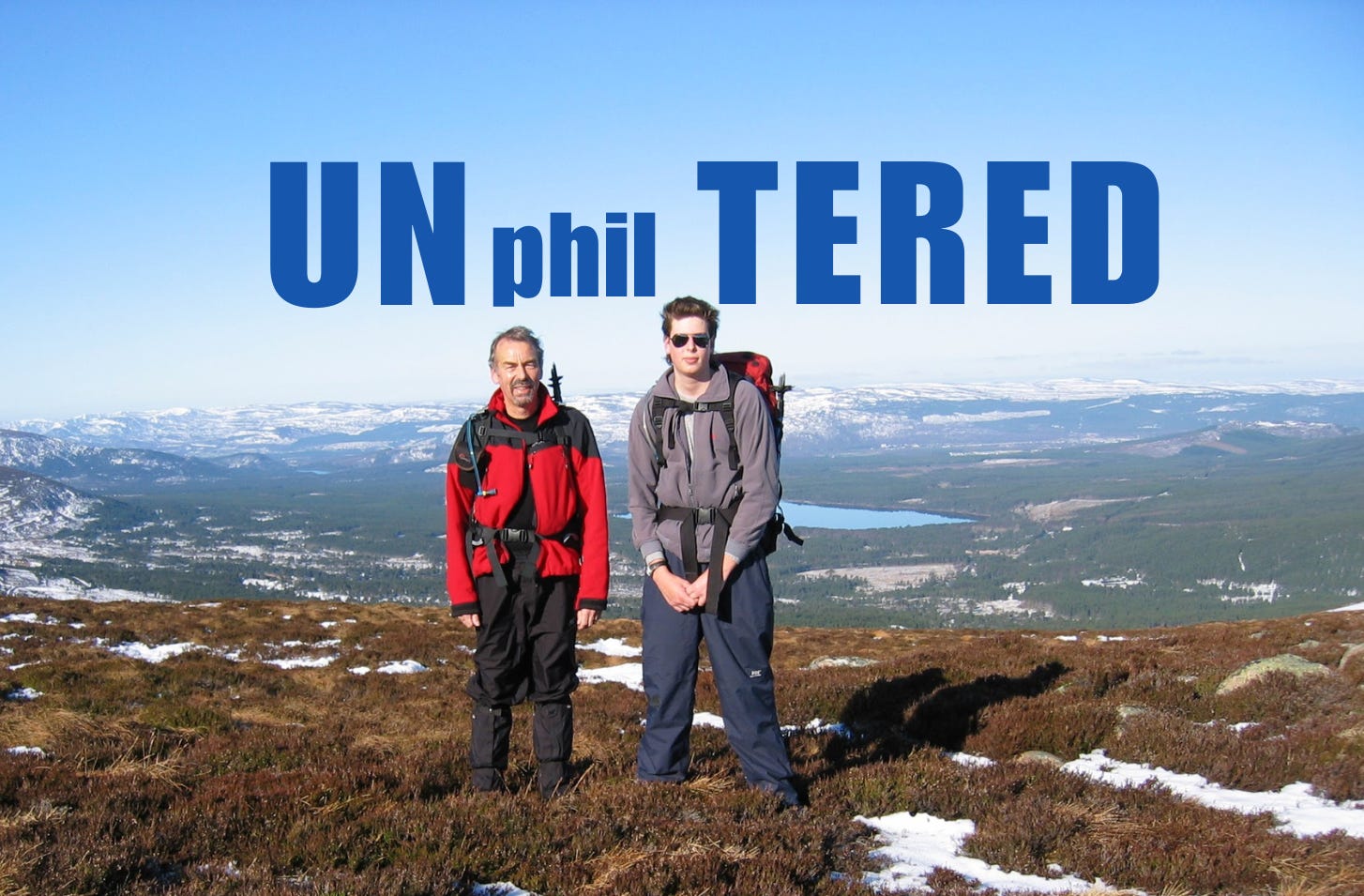
(pictured in Scotland, 2007).