
UnPhiltered (Part 4)
Catch up on chapters 13-16 of my writing-life story

Chapter 13 — Going fishing
In late 2021, I published my second book.
‘The Fisherwoman’ would make waves.
This time, I would succeed…
This book was similar to my first effort (previously published stories, distributed on Amazon), but everything about ‘The Fisherwoman’ would be better.
The stories were more ambitious and mature. They had been published in better-quality journals that paid, and a few had even been shortlisted or won competitions.
The diverse characters would appeal to all: a war deserter fighting disaster at the Hong Kong races, a French clown who can fly, a neuroscientist desperate to implement ‘organic AI’, a downtrodden preacher in Mississippi, a frazzled competitor at an international Scrabble tournament, a time-travelling cat, and more.
After five years of publishing fiction, I felt part of the community. I was a member of online writing circles, had 1,000+ Twitter followers and a mailing list, and was somewhat known to other short story authors and editors (especially in the UK).
I briefed and commissioned an artist friend of mine to design the cover (see it in the header image here)
I paid for proofreading and pro typesetting.
This time, I had a marketing plan, involving sharing story snippets, regular social posts, graphics, reviews, cover quotes, readings, and even paid ads. I contacted two professional short-story book critics to schedule detailed reviews (unpaid).
This was a more professional approach to self-publishing.
I was sure that, despite short story collections being less popular than genre fiction or self-help books, it would sell.
Well, I learned another hard lesson…
The Fisherwoman is the lowest-selling book of the five I have published to date.
I tried amending the description, the keyword ads, the book category, and how I promoted the book. I still don’t know why it sold fewer copies. Sometimes, creative endeavours fall flat.
But there was no time to lick my wounds, as I had to move on and market book three (released just 7 months later).
Some of the best things I’ve written are in that book (please indulge this self-plug).
Ultimately, you do the work for yourself. You do it for the quality of the story. And if just one person likes it, that’s sometimes enough.
Next time, I get my own back on a publisher that ghosted me by delivering the world’s-first Bitcoin story anthology.
Chapter 14 — The Orange Pill
Five years ago, I knew nothing about finance.
I couldn’t even answer the question ‘What is money?’
Then, one of my clients asked me a different question:
“Do you know what causes inflation?”
Niko was one of my first coaching clients. I was targeting publishers who wanted to improve the quality of their English writing, and he runs an independent press for Bitcoin and self-sovereignty books.
In the Bitcoin community, we talk about the concept of ‘orange pilling’ — helping others to understand the benefits of Bitcoin and escape the Matrix of our financial system. In reality, it’s not as easy as taking a pill; the necessary knowledge requires a long process of learning about economics, history, fiscal policy, computer science, game theory, money, energy, maths, and other topics.
There is often one ‘unlock’ moment (for me, it was suffering through 20% Covid inflation and finally taking action to combat it). After that, the real learning starts. Niko guided me towards many books on the topic, and I began to ask questions about why our financial system is rigged against us.
Bitcoiners favour open-sourcing everything and are against gating ‘intellectual property’. The fact that Niko would provide all his eBooks to me for free made me question my approach to publishing (and the whole industry itself). Perhaps I’ll reflect on this in a later issue.
A few months after we finished our coaching sessions, I hit upon an idea.
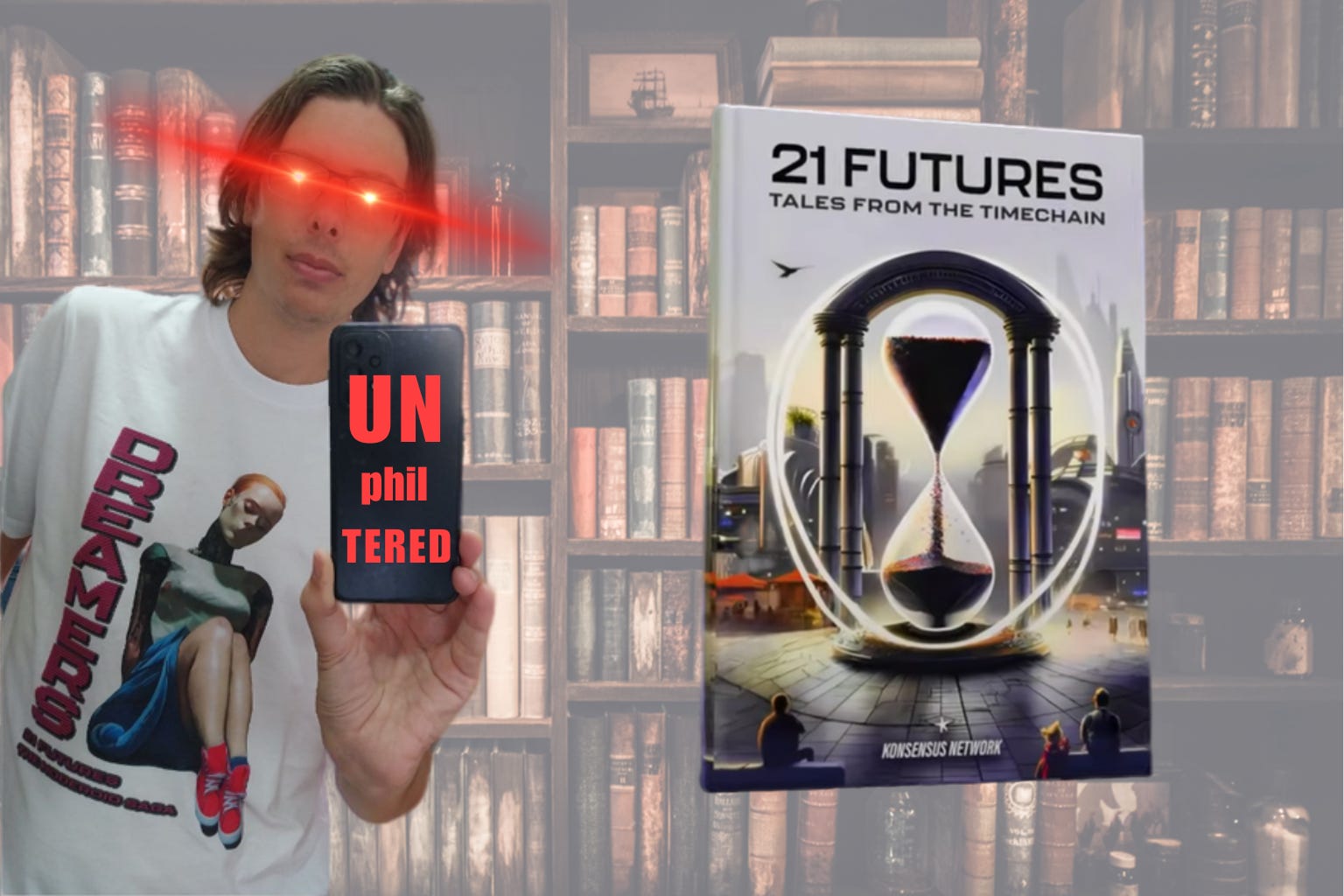
I’d just been ghosted by a publisher who had initially shown interest in an anthology idea of mine (a book of nomad stories). Instead of giving up on the idea of editing a book of stories, I suggested the concept of Bitcoin fiction to Niko. He is a big sci-fi fan and saw the value in ‘orange pilling’ people via stories (almost all Bitcoin books at the time were non-fiction theses). In late 2022, 21 Futures was born.
I only wrote one of the stories in ‘21 Futures: Tales from the Timechain’, but bringing an anthology to market requires a LOT of time and input from the editor. I defined the concept, advertised the call for submissions, communicated with all the authors, drew up terms and contracts, selected and edited the stories, worked with the Konsensus Network (the publisher) on the book design, cover, and images, created a marketing plan, set up socials, then a website, blog submissions guidelines, merchandise, and more. I travelled to a conference in Madeira to promote the book and meet the publishing team (including Niko).
While the book has not sold thousands of copies, it’s an important proof of work that furthered the concept of stories and fiction in the Bitcoin ecosystem. 21 Futures has become a bigger project, with podcasts, merchandise, a second book, and an animation in development. All of this became a flywheel of momentum for my involvement in the Bitcoin space, generating more opportunities, leading me down countless rabbit holes, and allowing me to make plenty of friends along the way.
Those sessions with Niko changed my life, and I’ll be forever grateful to him for his patience, guidance, and support (even though he was the one paying me, LOL).
I used to wonder what it took to become an editor, a publisher. For years, I had corrected and edited my students’ work, as well as my own. Essentially, you take the leap and learn as you go (taking courses, reading books, listening to authors). I’ve since edited several books in the space.
There is another saying in Bitcoin that rings true for me: “You can just do things.”
Chapter 15 — Scaling and failing
“Stop swapping your time for money.”
This is what we are told when we run a digital business.
Going from charging clients $45 per hour to selling online courses and access to your genius* feels empowering.
*disclaimer: I am not a genius.
Over the course of just a few years (2020-2024), my “English Writing Coach” business scaled in quantity of clients, quality of offering, and profit. Though I wasn’t getting paid to write, my work intersected with books, languages, and writing plenty of content.
I moved from 1:1 sessions to groups, then ran a paid community with 100+ members.
I was ‘vertically scaling’ my digital business. Sounds wonderful, right?
At times, it was. Helping clients achieve clear-cut wins (and charging handsomely) gives you higher highs than you can ever experience working for a company. Every like, download, purchase, and booking goes directly to YOU, not your dickhead boss. Every morning, I jumped out of bed ready to get to work.
As a business owner, you learn a bunch of skills — marketing, automations, video production, websites, copywriting, course design, digital publishing, community management, podcasting, and more. I still use those skills today.
But scaling is not all emails informing you of money in your Stripe account. There are dangerous consequences that, without careful management and a very particular personality profile, will bring the whole thing crashing down.
You need to constantly fail and adapt — products, courses, outreach strategy.
The learning curve is relentless. Halfway through my coaching career, AI reared its head (and I refused to robotize my business).
Not every client wins — their failures are your failures.
More overheads (like digital tools or hiring staff) means more risk. You constantly worry about going fast enough vs going broke.
You get no vacations because your whole business is YOU.
Your public and private life blends into one, and you become a wanker who turns the small niceties of life into LinkedIn content.
I know hundreds of coaches, and very few of them run sustainable businesses.
They either quit, pivot, or burn out. I did the latter.
For me, burnout took the form of self-sabotage.
My marketing posts went from comical to furiously sarcastic.
I tried to sell asynchronous courses and guides I didn’t believe in
The effort I put into live sessions waned.
I could not physically bring myself to complete the outreach tasks that would bring in clients and money.
The lows became crushing.
The highs more fleeting.
This kind of business just clicks for some people. They love building automation sequences, and systems with big promises (i.e. dollar signs) and lots of bells and whistles. But I became a marketing machine who taught others to market themselves. It all began to feel less like a writing program and more like a gigantic pyramid scheme.
Ultimately, I wasn’t honest with myself and kept going when something felt very wrong.
When I started writing content and copy for Konsensus, the words burst onto the page. Everything felt simple again.
I’m OK with swapping time for money, even if it means giving up the dream of waking up to all of those digital purchase notifications, then logging into social media to read all the wonderful praise.
Chapter 16 — Becoming Totally Human
I was kicking around some ideas about directions for my writing.
My business had already touched on articles, courses, fiction, editing, coaching, newsletters, and guides.
I settled on Bitcoin as a niche because it’s the only area I want to invest my energy in.
It might sound harsh, but if you are a freelancer, and you aren’t writing in a niche that resonates deeply with you, why do it at all?
The plus side of being a writer in Bitcoin is that there are very few creative professionals in the space with deep skillsets. I’m not saying that to put anyone down. It’s a small ecosystem compared to insurance, pet care, fashion, and other writing niches.
Clients are forthright. They do what they say, and they don’t mess you around.
It’s easy to meet them too — founders, industry leaders, investors, and top minds can all turn you onto projects that need words. All you need is a clear profile and the guts to meet them. Over the last two years, I’ve had dozens of calls and have been to quite a few conferences.
Really, it’s the same as any other industry: success comes from clarity, consistency, reputation, and who you know. (For more on ‘how I built a bitcoin writing business’, read my Bitvocation article).
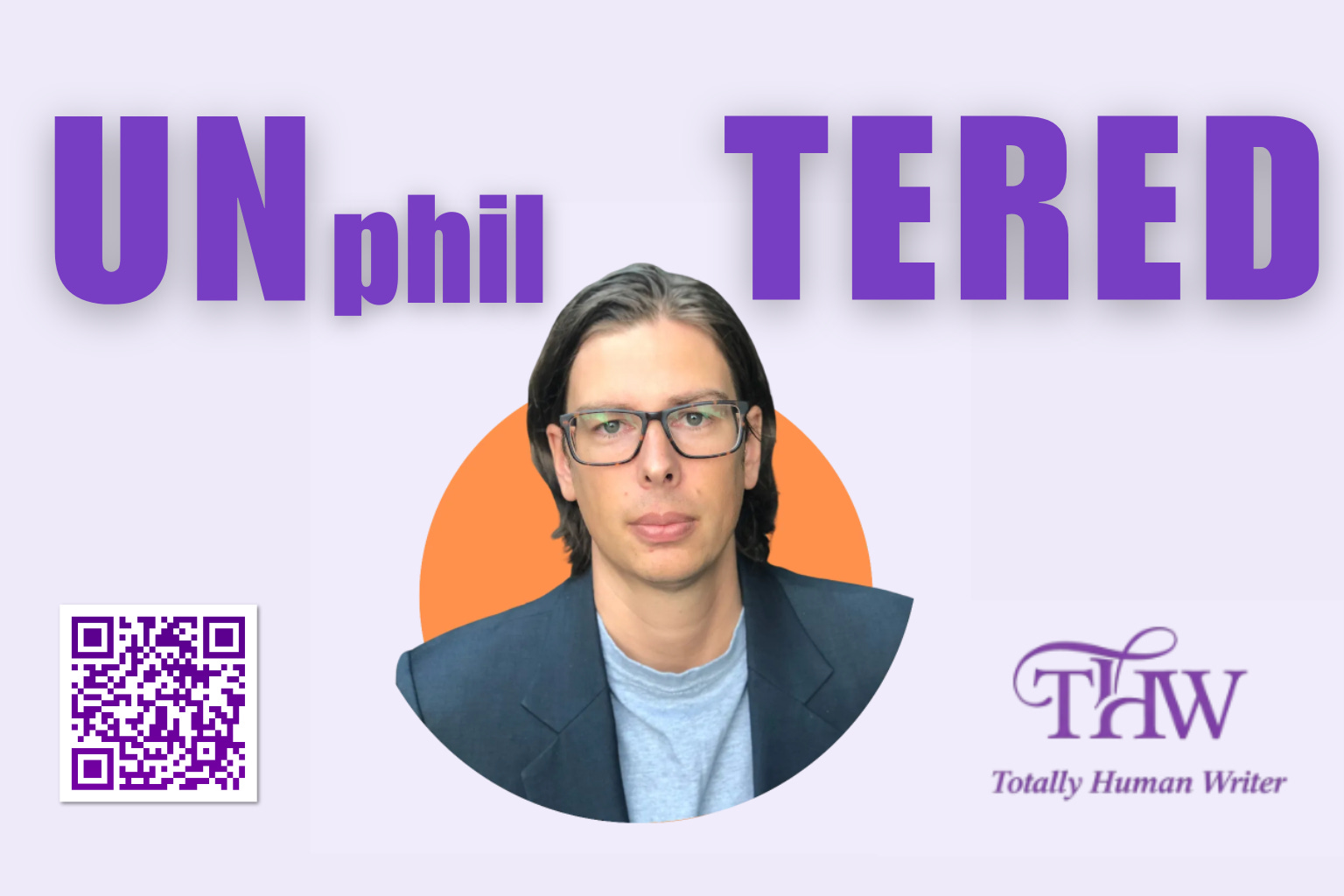
But in an industry that embraces AI with open arms, why call myself ‘Totally Human Writer’? Four reasons:
1. It shows my values.
I believe in communication that is human centric. I’m a fiction writer. How could I not want to write for people?
2. It’s clear positioning.
If you want someone to pump out social truisms, 3-step guides, and ‘top 10’ articles, that’s not me. Repelling the wrong clients is just as important as attracting the right ones.
3. It’s a mark of quality.
I aim to work on high value projects, not $50 per keyword-stuffed blog content.
4. Purple monkey dishwasher
(would an LLM write that???)
Overall, I’m not against AI. That is not a position that’s tenable anymore.
I use Lumo for quick research, lists of items, quotes, and to summarize books and podcasts.
But using it to actually write just takes all the joy and meaning away.
Contrary to what AI shillers say, meaningful writing is worth more than ever before.
LLMs produce millions of words virtually for free. That’s why the internet is filled with shit content and no-one’s marketing is working any more.
There is no magic formula for cutting through the sea of slop.
As with anything, it’s about time, effort, and value.
We’re in the period where entrepreneurs and founders are figuring out what they can and can’t automate. Certain types of writing tasks can be automated. But if you automate your vision, message, and reduce the time spent in your community, your authenticity trends to zero too.
I recently read a podcaster’s book. I’m the perfect age to be in his target audience, so I was keen to see how he’d relate Bitcoin to my struggles. The book was written with AI (maybe 20-30% was the author’s work). It was awful. I felt no connection to his experience, his opinions. If he couldn’t put the work into writing it, why should I bother to read it?
Machine content is always derivative, and derivative work is less valuable than original work.
When ChatGPT started eating freelancers’ lunches (mostly due to short-sighted budgetary decisions), I thought long and hard about what AI can never do:
Invent novel analogies & frameworks
Understand biology & the mind
Generate niche humour
Vary voice effectively
Share experiences
Offer real opinions
Write with rhythm
Craft stories
We read to learn things. But we also read to connect with others.
We don’t feel a connection with billion-page internet libraries.
Technology advances at an exponential pace, but human connection is one thing I think won’t change.
Next time, I become a children’s author.